Vibe-Coding: What It Is & How AI Is Changing The Way We Write Code
Remember when coding meant staring at a blinking cursor, trying to recall the exact syntax for a useEffect hook? That feels like a lifetime ago. Today, vibe-coding has completely shifted the landscape of software development, turning us from manual laborers of code into architects of logic.
In this guide, you’ll learn exactly what vibe-coding is, why it’s the standard for high-performing engineering teams in 2026, and how you can master this workflow without sacrificing code quality.
What Actually Is Vibe-Coding?
At its core, vibe-coding is the practice of "coding by intent." Instead of writing every line of syntax yourself, you describe the behavior, the constraints, and the desired outcome—the "vibe"—to an AI model, which then handles the implementation details.
It sounds simple, but it's a fundamental shift in responsibility.
- The Old Way (Pre-2025): You write the loop. You write the API call. You debug the semicolon.
- The Vibe Way (2026): You tell the AI, "Fetch the user data, cache it for 5 minutes, and handle the 404 state gracefully." The AI writes the loop, the API call, and the error handling.
In 2026, we don't judge a developer by their ability to memorize standard library functions. We judge them by their ability to articulate complex problems clearly enough for an AI to solve them correctly.
The "Vibe" Workflow in Production
I’ve been using this workflow in production environments for over a year now, and the speed difference is undeniable. But it's not just about speed; it's about staying in the "flow state."
Here is what a typical vibe-coding session looks like:
- Context Loading: I open my IDE (which, let's be honest, is basically an AI wrapper now) and ensure the relevant files are in the context window.
- Intent Declaration: I type a prompt like, "Refactor this auth component to use the new server actions we added in
actions.ts. Keep the validation logic same." - Generation & Review: The AI generates the code. I didn't type a single bracket.
- The "Vibe Check": I review the code. Does it look right? Does it handle edge cases? I run the tests.
- Iteration: If there's a bug, I don't fix it manually. I tell the AI, "You missed the loading state," and it fixes it instantly.
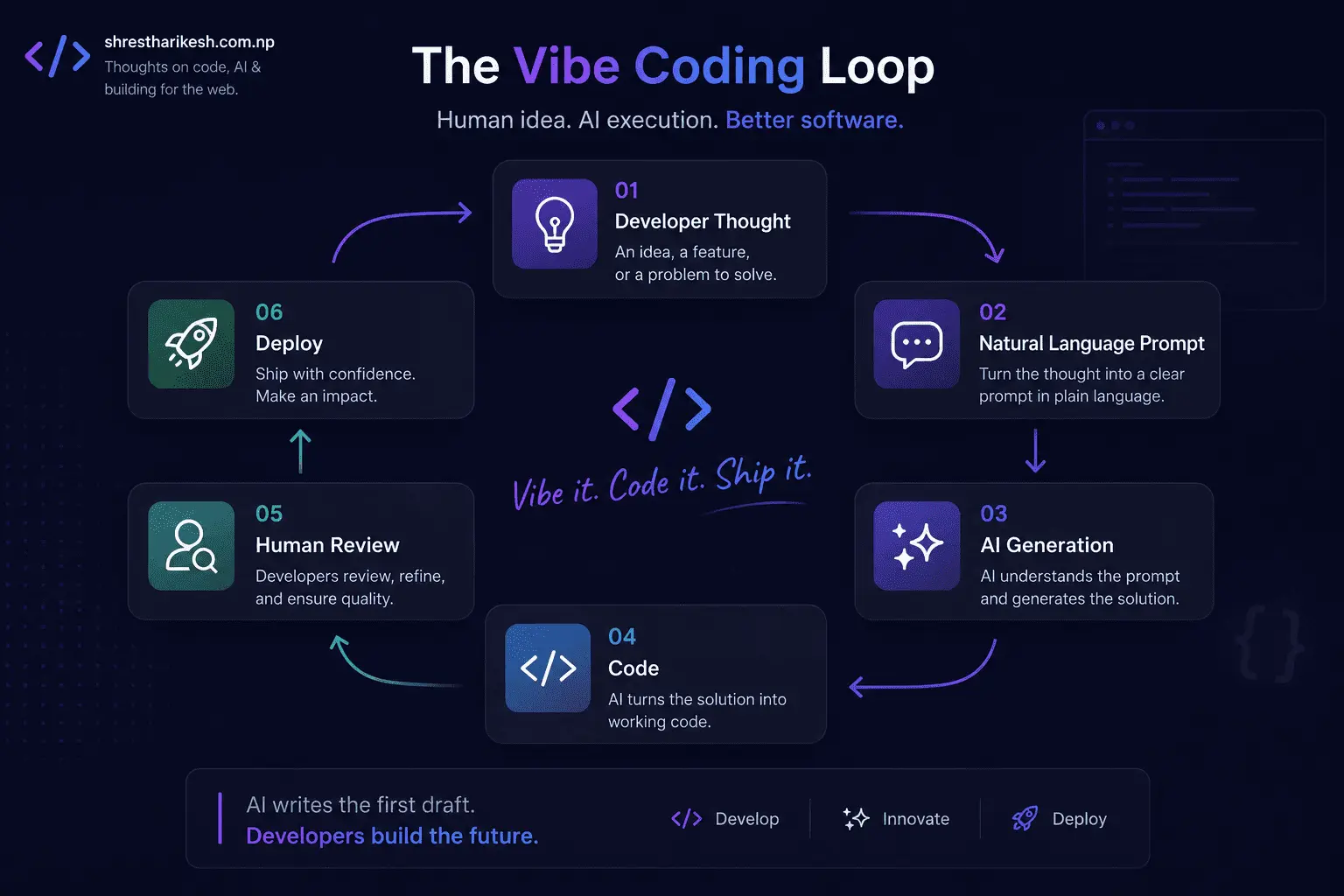
From experience, I spend about 80% of my time reviewing architecture and logic and only 20% actually writing code. This inversion allows me to build features in hours that used to take days.
Why It's Not Just "Lazy" Coding
There’s a common misconception that vibe-coding is for lazy developers or those who don't know how to code. This is false.
To vibe-code effectively, you need more domain knowledge, not less. When the AI hands you a complex React component or a Python script, you need the expertise to spot:
- Security vulnerabilities (did it just import a hallucinated package?)
- Performance bottlenecks (is that an O(n²) loop?)
- Architectural drift (does this match our project's patterns?)
If you don't understand the code, you aren't vibe-coding; you're just gambling.
Practical Steps to Vibe-Code Safely
If you’re ready to fully embrace this workflow, here are the rules we follow in our team to keep our codebase clean:
1. Context is King
An AI without context is a junior developer making guesses. Always ensure your AI tool has access to your types, utils, and related components. If you're using Next.js, make sure it knows you're using the App Router, not the Pages Router.
2. Iterative Prompting
Don't ask for a fully functional e-commerce dashboard in one prompt. Break it down:
- "Create the database schema for products."
- "Now, create the API route to fetch them."
- "Finally, build the UI component to display the list."
3. The "Sniff Test"
Develop your intuition. If the generated code looks too complex, or if it's importing three different libraries to do a simple task, trust your gut. The "vibe" is off. Reject it and ask for a simpler solution.
The Risks We Don't Talk About Enough
It wouldn't be honest if I didn't mention the downsides. In real projects, "AI drift" is a real problem. This happens when different parts of your codebase are written by different AI personalities—one part functional, one part object-oriented, one part strictly typed, one part loose.
You must enforce strict linting rules and code reviews. AI writes the code, but you own the standards.
Conclusion
Vibe-coding isn't just a trend; it's the evolution of our craft. It frees us from the tyranny of syntax and allows us to focus on what really matters: solving problems for our users. By shifting from a writer to an editor, you can build faster, think bigger, and enjoy the process more.
So, stop fighting the tools. embrace the vibe, but keep your eyes open.